Why support Muslim-owned businesses
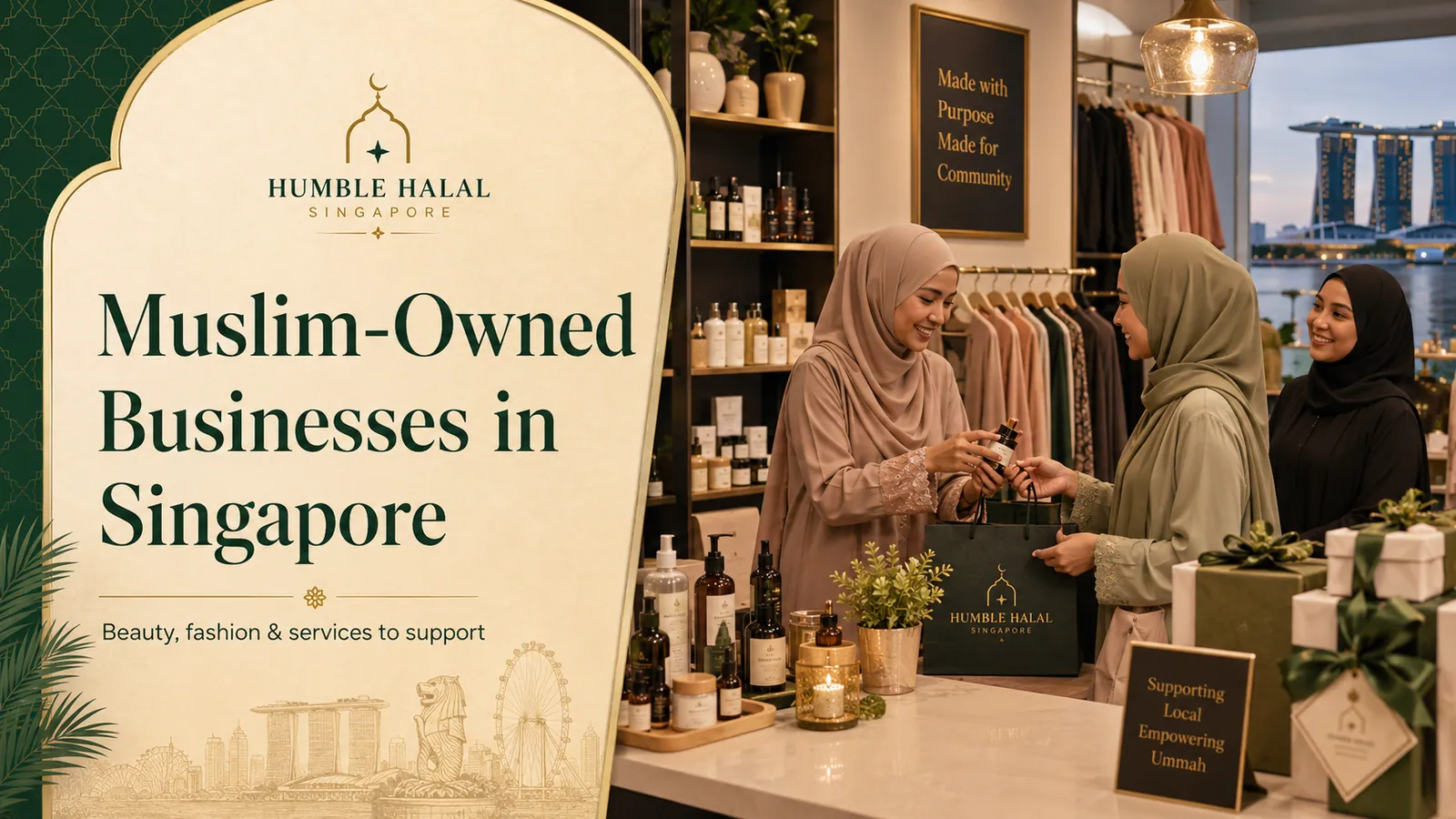
Choosing Muslim-owned businesses keeps money circulating in the community and supports entrepreneurs who often started small. Many are home-based businesses — the quiet backbone of the community economy — run from a spare room, a kitchen or a converted corner of the flat, alongside a day job or family responsibilities.
For food, MUIS certification is the gold standard. But most of these businesses are not food, and for them certification simply does not apply — the meaningful signal is who owns and runs the business, and how they run it.
Categories to explore
The range is wider than most people expect. Beyond the obvious beauty and fashion labels, there is a deep bench of home services, professional help and lifestyle businesses run by the community — many bookable directly and increasingly listed in one place.
- Muslimah beauty & hair salons — including private, women-only and home-based studios
- Modest fashion — abaya, hijab and modest-wear labels, many independent and local
- Home services — renovation, cleaning, aircon servicing and handyman work
- Automotive — workshops, servicing and car grooming
- Tuition & education — academic tuition, Quran and enrichment classes
- Events & photography — weddings, akikah, catering coordination and videography
- Health & wellness — confinement care, massage, cupping and fitness
“For non-food businesses there is no certificate to lean on — the trust signal is Muslim ownership and how the service is run.”
The Humble Halal TeamMuslim-owned vs Muslim-friendly — how we label
Non-food businesses on Humble Halal carry a Muslim-Owned or Muslim-Friendly label rather than a MUIS certificate, because MUIS certification covers food and beverage. Muslim-Owned means the business is owned and run by members of the community; Muslim-Friendly means it caters thoughtfully to Muslim customers without necessarily being Muslim-owned.
The listing tells you how the business describes itself, and the halal-confidence score is weighted for that context — so you can choose with the same clarity you would when picking where to eat, even though certification is not part of the picture here.
New MUIS-verified spots, mosque events & deals across Singapore — free, every week.
How to choose well
Without a certificate to lean on, a little judgement goes a long way. The good news is that the signals are the same ones you already use for any service — reputation, clarity and how the business communicates.
- Read recent reviews and look at real work, not just polished promo photos
- Check how the service is run — women-only hours, privacy, and clear pricing
- For home-based businesses, confirm the setup and etiquette before booking
- Message with your specific needs and see how promptly and clearly they reply
Home-based businesses — a quiet backbone
Home-based businesses (HBBs) deserve a special mention. Many of the community’s best salons, bakes, tailors and tutors operate this way, offering a personal, often more affordable service than a shopfront. They can be harder to discover precisely because they do not have a storefront — which is exactly why a directory helps.
Treat an HBB as you would any small business: agree on scope and price up front, respect that it is someone’s home, and leave an honest review afterwards so the next customer benefits from your experience.
Find them — and get listed — on Humble Halal
To support the community, browse by category on Humble Halal and filter for Muslim-Owned to surface beauty, fashion, home services, education and more. Open the map to find businesses near you, read the reviews, and use the labels to understand exactly what each listing offers before you reach out.
- Filter by category and the Muslim-Owned label to browse the community
- Use the map to find services close to your neighbourhood
- Run a business? Add your listing so customers can find and review you
- Leave honest reviews to help others choose with confidence