What does “halal” actually mean?
Halal is an Arabic word meaning “permissible”. For food, it means the ingredients, preparation and handling all follow Islamic dietary law. The opposite of halal is haram (“forbidden”) — most notably pork and its derivatives, alcohol, and meat that wasn’t slaughtered according to Islamic rites.
In day-to-day Singapore, when someone asks “is this halal?” they usually mean two things: does it avoid haram ingredients, and is it officially certified by MUIS?
Who decides what’s halal in Singapore?
The Islamic Religious Council of Singapore — MUIS — is the sole body that issues halal certification here. MUIS audits the whole operation: ingredients, suppliers, storage, preparation and even cleaning. An establishment that passes gets a MUIS halal certificate, which it must display and renew.
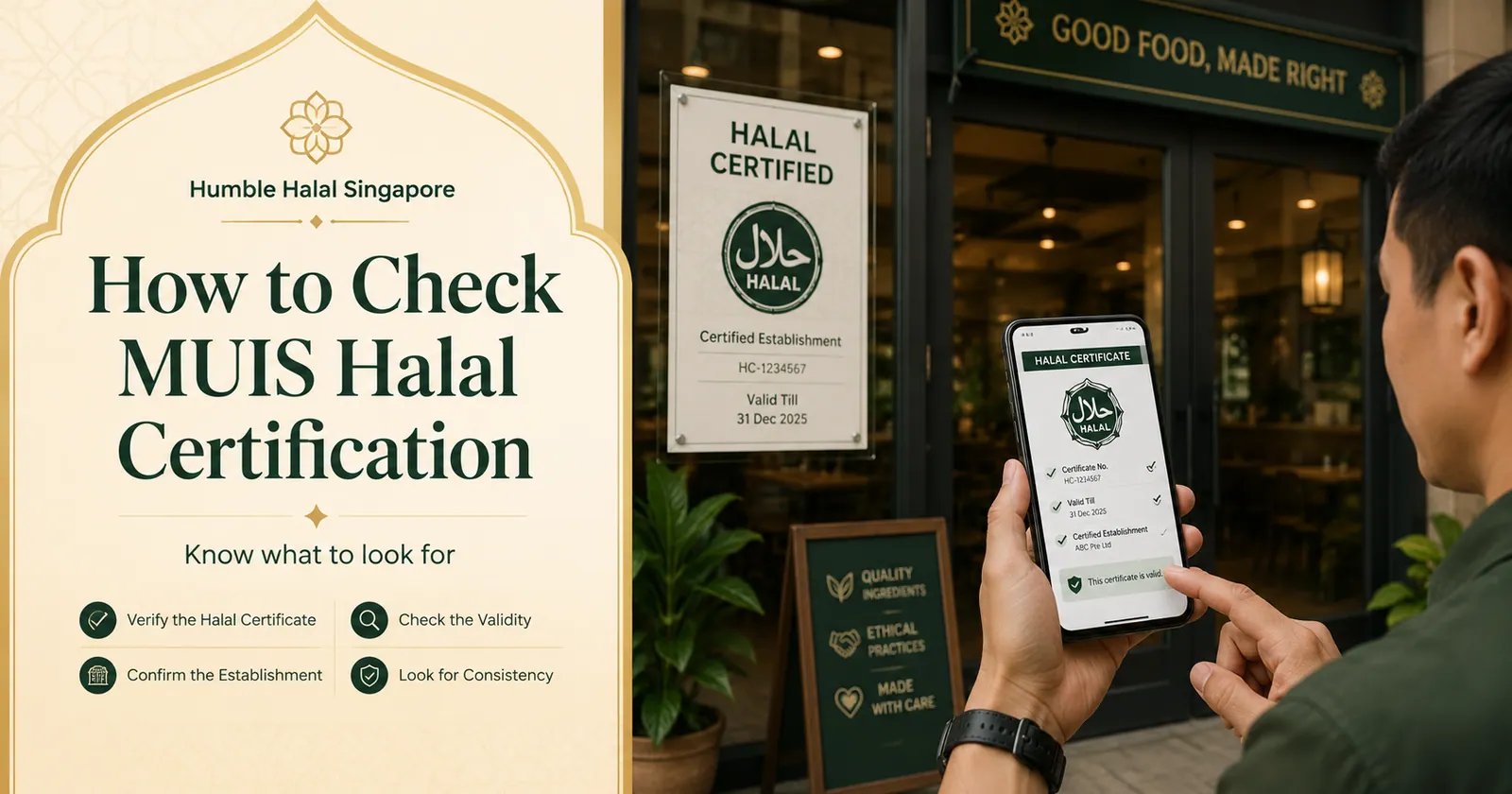
You can check any establishment on the official MUIS HalalSG register. If it’s not listed, it isn’t MUIS-certified — regardless of any signage.
“No pork, no lard” is a helpful signal — but it is self-declared, and it is not the same as MUIS certification.
The Humble Halal Team“No pork, no lard” is not the same as halal
Plenty of eateries put up a “no pork, no lard” sign. That’s a helpful signal, but it’s self-declared and only covers those two ingredients. It says nothing about alcohol in sauces, non-halal chicken or beef, shared fryers, or cross-contamination.
If certification matters to you, treat “no pork, no lard” and “Muslim-owned” as softer signals and confirm the MUIS certificate for the specific outlet.
New MUIS-verified spots, mosque events & deals across Singapore — free, every week.
How Humble Halal’s halal-confidence score works
Because the real world is more nuanced than a yes/no, every listing on Humble Halal shows a halal-confidence score from 0–100. MUIS-certified places score highest, followed by admin-verified and Muslim-owned, then self-declared “halal-friendly” or “no pork no lard”. It’s a quick way to judge how confident you can be before you go — but the official MUIS register is always the final word.
Common haram ingredients to watch for
Beyond pork, a handful of everyday ingredients can quietly make a dish non-halal. The usual culprits are alcohol used in cooking, gelatine or rennet from non-halal sources, lard and animal shortening, and meat that simply wasn’t slaughtered the Islamic way. This is why “it looks meat-free” or “there’s no pork” isn’t the whole story.
- Pork and all derivatives — bacon, ham, lard, pork gelatine
- Alcohol in cooking — mirin, Shaoxing/cooking wine, rum or liqueur in desserts
- Gelatine & rennet — common in jelly, marshmallows, mousse and some cheeses
- Non-halal beef or chicken — even at a “no pork” stall
- Emulsifiers & enzymes (e.g. E471, L-cysteine) that can be animal-derived
Halal-certified, Muslim-owned or “halal-friendly”?
These three labels get used loosely but mean very different things. MUIS halal-certified is the only official verification — the kitchen, ingredients and supply chain have been audited. Muslim-owned tells you about the owner, not necessarily the certification. “Halal-friendly” or “no pork, no lard” is a self-declared courtesy that nobody has checked.
None of these are wrong to consider — they simply sit at different levels of confidence, which is exactly what the halal-confidence score is built to capture.
Is seafood or vegetarian food automatically halal?
Most seafood is considered halal by the majority of scholars, and plant-based food is halal in itself. But “the ingredient is halal” doesn’t always mean “the dish is halal”. A vegetarian plate can still be cooked with cooking wine, and seafood can share fryers or woks with non-halal items.
If certification matters to you, the safest move is still to check the specific outlet on HalalSG rather than assume from the menu category alone.